Canada goose control using trained border collies has been covered by national trade publications and newspapers over the years. Geese Chasers South Jersey & Delaware serves the New Jersey counties of Atlantic, Cape May, Cumberland, and Salem, along with the Delaware counties of Kent, New Castle, and Sussex, under franchise owner Kerri Stinger. The coverage below starts with reporting on our own franchise, then moves outward to the national and trade stories that explain the method, followed by what all of it means for property owners here.
Franchise Times Features Our Own Kerri Stinger

A December 2021 profile in Franchise Times went straight to the source on why the method works, quoting Kerri Stinger, our South Jersey franchise owner, on why dogs succeed where decoys fail. Flashing lights, fox statues, and sonic devices all stop working once geese get used to them and start ignoring them. What geese never adjust to, Stinger told the magazine, is a vehicle pulling up and real dogs coming out after them. “We change the habits of the geese,” she said, noting that programs are priced from about $499 to $1,600 a month depending on how tough the job is.
The same piece traced the company back to founder Bob Young. In 1998, a local golf course owner noticed Young’s border collie Boomer and asked whether the dog might clear the geese that had overrun his course. Boomer cleared roughly 500 birds in about a week, and Young went on to establish the first Geese Chasers business in May 2002. The article also profiled North Jersey franchisees Joe and Brooke Bello, whose client list includes Central Park in New York City and Liberty State Park across from the Statue of Liberty, giving a sense of how far the network Kerri operates within actually reaches. Brooke Bello described results on a tough account dropping from about 200 geese to roughly 30 within the first week of service.
Read it: Franchise Times: Got Pesky Geese? This Franchise Has a Canine Solution
National Newspaper Coverage

The New York Times: Why Border Collies Work
An April 2023 interview with founder Bob Young explains the mechanism behind the method. Geese respond to border collies because the dogs resemble arctic foxes, one of their few natural predators. Young said he had tried Australian shepherds and Labs early on and the geese ignored them. The article describes a twelve week tracking study finding that two chases kept geese off a property about two weeks, while four chases stretched that to roughly four weeks. It also notes geese pull grass up by the roots and leave droppings acidic enough to change soil pH, so damaged turf often returns as weeds.
Read it: The New York Times: His Business? Hiring and Managing Dogs to Chase Geese.

The Times of London: The Population Story
This UK article traces the Canada goose from roughly 250,000 birds in 1970 to about 3.5 million by 2010, crediting the Migratory Bird Treaty Act with the recovery. It notes that corporate parks and their landscaped retention ponds built close to perfect goose habitat, and that droppings can carry bacteria including E. coli, which is why parks, ball fields, and waterfront properties usually act first.
Read it: The Times: Want to get rid of a goose? Take a gander at these border collies
Business and Trade Coverage
ROI-NJ: How Service Is Actually Structured
This February 2023 profile is the most practical of the group for facilities managers, since it covers logistics rather than origin story, and it happens to be about our own backyard: founder Bob Young runs the company out of Mount Laurel, right here in South Jersey, which is where the whole network started. It reports that the number of ponds on a site shapes the plan more than total acreage does, and that service should be running by mid February through mid March, ahead of nesting.
Read it: ROI-NJ: Meet Bob Young, South Jersey man who stumbled into service

Golf Course Industry: The Turf Manager’s View
Written for golf course superintendents, this trade piece recaps the company’s growth from that single New Jersey course in the late 1990s out to franchises across ten states. The framing is what matters for South Jersey and Delaware clubs: superintendents treat goose damage as a turf and playability problem, not only a cleanup one, since feeding geese pull grass out by the roots and leave greens and fairways needing repair rather than just washing down.
Read it: Golf Course Industry: Geese Chasers opens in Northern Virginia
Broadcast and Video Features
Several segments show the dogs working, which tends to land better for property managers than any written description. Four are worth watching, starting with the one filmed closest to home.
Paws For Pets: Geese Chasers
A South Jersey news program devoted a featured story to Geese Chasers and the border collie method. This is the segment shot nearest our own service area. Watch the Paws For Pets feature.

CBS2 New York: Chasing Geese is for the Dogs
CBS2 covered the dogs at work on New York City’s goose problem, showing a full clearing in progress. Watch the CBS2 New York segment.
Nutley, New Jersey Hires Geese Chasers
This segment follows a New Jersey municipality bringing in Geese Chasers to reclaim its parks system, which is the closest thing in the archive to a municipal case study. Watch the Nutley segment.

In The Know: A Geese Chasers Special Feature
AOL’s In The Know series produced a standalone feature on the company and the method behind it. Watch the In The Know feature.
What This Coverage Means for South Jersey and Delaware Properties
Three findings run through all of it. The birds here are resident rather than migratory, so they do not leave on their own. Federal protection under the Migratory Bird Treaty Act, along with New Jersey and Delaware state law, rules out removal without permits. And results come from repetition, because geese only reassess a property after being moved along many times.
The Jersey Shore’s bay towns and Delaware’s coastal communities share a habitat quirk that makes them prone to heavier goose activity than inland areas: a high concentration of tidal marshland, retention ponds, and irrigated turf sitting close together, which gives geese both a food source and easy escape water in the same small footprint. That’s part of why goose problems tend to be more persistent in shoreline towns across Cape May and Atlantic counties in New Jersey, and in New Castle and Sussex counties in Delaware, than in areas further from the coast.
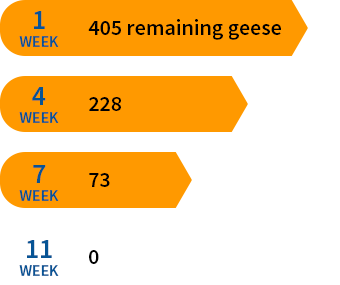
That shapes how the work runs. Handlers service properties seven days a week, multiple times a day, and the initial flock typically clears in four to twelve weeks. Daily maintenance then keeps new resident and migratory birds from settling in, since their first experience on the property is being moved off it. An on call option covers sites needing periodic clearing, with response inside an hour during service hours, and night runs handle roosting piles from birds arriving after dark. Nesting season runs March through June, and once a nest hatches, goslings cannot fly for roughly 70 to 90 days and cannot legally be harmed or relocated, which commits the property for that whole stretch. Because geese are habitual nesters that return to sites where they successfully raised young, acting early in the season changes next year as much as this one.
Geese Chasers South Jersey & Delaware
Geese Chasers South Jersey & Delaware provides humane Canada goose control for commercial properties, golf courses and clubs, residential communities, and municipal sites across Atlantic, Cape May, Cumberland, and Salem counties in New Jersey, and Kent, New Castle, and Sussex counties in Delaware. The Humane Society of the United States has identified trained goose herding dogs working with a handler as the most effective way to move geese off a property. Every program is built around the property’s layout, water features, and how it’s actually used.
Get a Free Quote for Your South Jersey or Delaware Property
Call (856) 904-5036 to speak with one of our representatives.
Geese Chasers™ Case Study
Geese cleared over 11-week program