Bay-town and coastal properties across South Jersey and Delaware share a specific problem: tidal marshland, retention ponds, and mowed turf often sit close enough together to give Canada geese food, water, and an easy escape route in one small footprint. That combination is part of why goose populations settle in quickly, and why generic deterrents rarely hold up. Geese Chasers™ South Jersey uses trained Border Collie and handler teams instead, built around a method that convinces geese a property is actively unsafe rather than just inconvenient to visit.
This service area covers South Jersey’s Atlantic, Cape May, Cumberland, and Salem counties, along with Delaware’s Kent, New Castle, and Sussex counties.
The Science Behind Border Collie Geese Control
Border Collies were bred by shepherds in the border country between Scotland and England, starting in the 1700s, specifically to stalk and herd. Facing geese, the dog crouches low, stalks, and holds a steady, wolf-like gaze, a posture geese read as an active predator. The dog never makes physical contact with a goose, a pet, or a person; the entire method relies on instinct and repeated presence rather than confrontation. That distinction, a live threat versus a static prop, is what separates this approach from scarecrows or noisemakers.
Our Service Programs at a Glance
Properties typically move through two or three of the following programs, depending on how established the flock is and how the site is used.
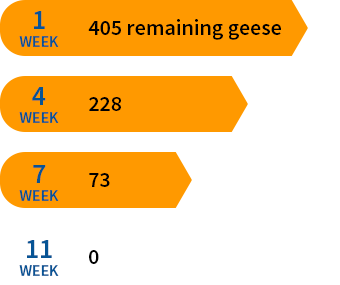
Initial Clearing lasts 4 to 12 weeks and involves multiple daily visits as needed. This phase does the heavy lifting: repeated, unpredictable visits build enough pressure that most resident flocks relocate within that window.
Maintenance is an ongoing program with daily visits as needed. It keeps the property from becoming attractive again once the initial flock has cleared.
On-Call is also ongoing. A handler responds within about 60 minutes of your call whenever geese reappear.
Night Runs are scheduled after roosting piles are spotted and can be added as needed to address after-hours activity.
Everything after the Initial Clearing phase focuses on preventing the property from becoming a long-term nesting or roosting site again.
When Other Deterrents Fall Short
Canada geese are monogamous, can live past 30 years, and reliably return to a nesting site where they’ve successfully raised young before. That means an established flock, one that has nested on a property for a few seasons running, is harder to move than a flock that just arrived. Scarecrows, mylar tape, and noisemakers rarely change that calculation, since none of them behave like a real, ongoing threat. Acting early, before a flock builds that kind of site loyalty, tends to produce faster results than waiting until the population is already settled in.
The tidal marsh and retention-pond geography common to this region compounds the problem, since geese that get pushed off one pond can simply walk or fly to the next one a few hundred yards away. That’s part of why a coordinated, property-wide visit schedule tends to outperform a single fixed deterrent placed at the water’s edge.
Egg Addling and Nesting Season Compliance
Nesting season runs from March through the end of June. If a nest is found before hatching, Geese Chasers™ can apply for the required state and federal permit to addle the eggs, halting development, within roughly the first 7 to 10 days after laying, given the 28-day gestation period. Once addled, the parent geese typically abandon the nest on their own. If goslings have already hatched, federal law prohibits harming or removing them, and the family remains on-site for about 70 to 90 days until the goslings can fly.
Frequently Asked Questions
What does service cost in South Jersey or Delaware?
Cost depends on property size, flock size, and program length. A free site visit comes first, followed by a quote built around the property.
How long until the geese are gone?
Most properties see the resident flock clear within 4 to 12 weeks under the Initial Clearing program.
Do the Border Collies ever harm the geese?
No. The dogs herd and chase only; there’s no contact with a goose at any point.
Which counties are covered?
South Jersey’s Atlantic, Cape May, Cumberland, and Salem counties, plus Delaware’s Kent, New Castle, and Sussex counties.
Can a nest be cleared at any time of year?
No. Egg addling is only permitted within a specific early window, and hatched goslings are protected under federal law regardless of season.
What happens once the initial flock clears?
The property moves into either a Maintenance program, with continued daily visits, or an On-Call program, where a handler responds within about 60 minutes of a request.
Is this method different for golf courses or HOAs versus a single home?
The underlying method is the same; the difference is scope. Larger or shared properties, like golf courses, common areas, and HOA grounds, usually need a longer initial route and more handler visits per day to cover every roosting and feeding spot.
Why Choose Geese Chasers™ South Jersey and Delaware
- Locally operated by franchise owner Kerri Stinger, serving South Jersey and Delaware directly.
- Coverage across Atlantic, Cape May, Cumberland, and Salem counties in New Jersey, plus Kent, New Castle, and Sussex counties in Delaware.
- Free, no-obligation site evaluation before any service agreement.
- Multiple daily visits during Initial Clearing, seven days a week.
- On-call scheduling adjusted directly by a regional manager as new sightings come in.
- Backed by the wider Geese Chasers™ network’s long-running experience in goose management.
Geese Chasers™ South Jersey and Delaware, led by franchise owner Kerri Stinger, serves commercial, residential, and municipal properties across both regions using this Border Collie method.
Ready for a free site evaluation?
Call (856) 904-5036.
You can contact us online too.
Advice is always free.
Geese Chasers™ Case Study
Geese cleared over 11-week program